
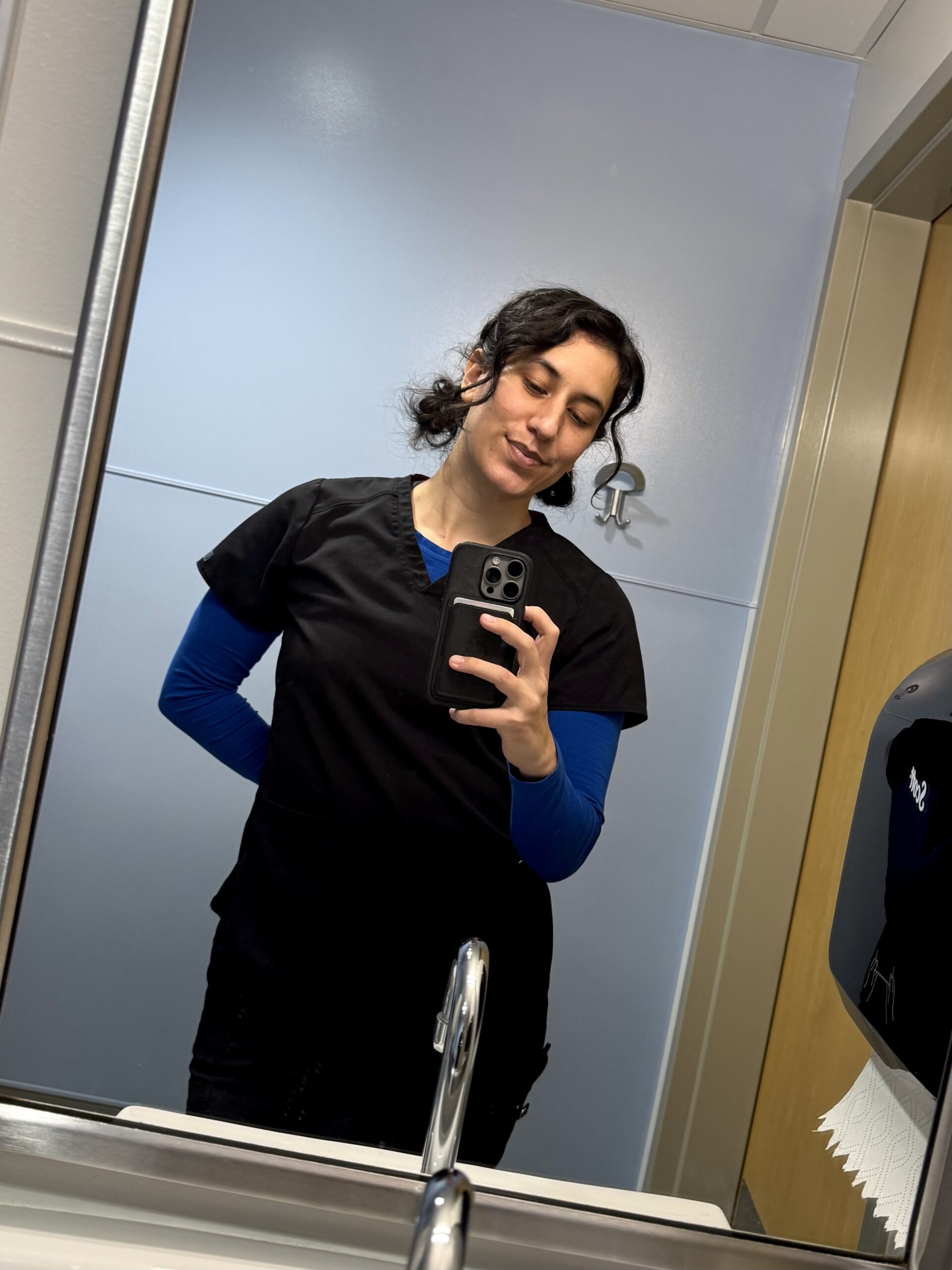




I used to think I’d never love nursing.
I became a nurse not because I had a lifelong “calling” to be one, but because it was practical. I survived nursing school (barely, let’s be honest 🤣), and then found myself thrown into bedside nursing at 22 years old…wiiildly unprepared for the emotional and existential weight of what was to come.
Nursing can take way more than it gives.
You’re expected to make split-second, life-altering decisions, manage multiple patients who all have orders from several different medical teams, and chart every detail like a courtroom transcript, all while quietly absorbing other people’s fear, anger, resentment, grief, hope, etc.
So yah, there is real harm that this profession can cause because of that, and so much more.
It makes sense that we talk a lot about burnout in this profession (because hellooo, it’s everywhere), and those conversations often lead straight to escape routes:
→ Remote roles.
→ Entirely new industries.
→ Businesses that let us shed the “nurse” identity completely.
We often romanticize leaving the bedside like it’s the only way to survive our career and live the life we actually want.
And trust me, I get it.
But what we don’t talk about as much is what happens after you leave. Because, in my experience, leaving the bedside wasn’t exactly the “freedom” I had been looking for, which I gotta be honest…was surprising AF.
And what it’s actually looked like is my realization that I love nursing (which I never thought possible), and it has led to my even more surprising choice to return to patient care with more awareness, more boundaries, and a very different relationship to the work itself.
So when I talk about falling back in love with nursing now, it still catches me off guard.
Because the truth is…
I didn’t even know I loved it to begin with.
Leaving Bedside Nursing: An Act of Self-Preservation
I spent my first 6 years in a conventional bedside nursing role as an acute care, medical-surgical nurse, and during a travel nursing assignment in 2022, I really felt like if I wanted to survive my career, I needed to leave.
At that time, leaving the bedside was purely an act of self-preservation.
Hindsight being 20/20, I can see now that I had been holding my grief and the gravity of death for a long time without the tools to actually process everything I was witnessing.
As you know, no one really teaches you how to cope with the life-altering experiences that come with this profession.
I certainly knew how to keep functioning in the workspace. I knew how to compartmentalize and get sh*t done. I knew how to show up when I was scheduled to work and just keep going (with Finding Nemo’s Dory as my personal pep-talker, “just keep swimming, just keep swimming…” lol 🐠).
But unprocessed grief has a way of finding you when you least expect it. Mine showed up one night during a travel assignment in my last month as a bedside nurse, when I sat down for dinner with two complete strangers.
I had just come off a succession of shifts during which I had multiple patient deaths while experiencing the toll of dangerously short-staffing.
In the middle of making small talk — where we were from and what we did for work, you know, the usual surface-level conversation you have with people you don’t know and probably won’t ever see again — when our host asked me a simple question: “How do you cope with it all?”
Before I could even form a coherent thought, I was full-on ugly crying right there in the middle of our entrees — I’m talking like the ugliest ugly-cry you can imagine.
I remember feeling embarrassed, but mostly I felt confused. Why now? Why here? Why with these people?
Later, I realized that moment was really an accumulation of all the years of holding other people’s pain without having a place to put my own.
So, I left the bedside towards the end of 2022 for a full-time, semi-remote role as a quality nurse consultant.
At the time, it felt like the most responsible decision I could make for myself, because I was exhausted in ways that went beyond being “just tired.” My nervous system was constantly on edge, I was crying more often than I care to admit, and the emotional weight of being a bedside nurse had started to feel unmanageable.
Returning to Patient Care: Choosing the Unexpected
When I left bedside nursing originally, I assumed that leaving meant I was done for good.
I genuinely believed that being behind a desk would fix everything.
No one was dying. No one needed saving. No one depended on me to make split-second, life-altering decisions.
I had space to exist without bracing for the next crisis. On paper, it looked like the right move. And in many ways, all that did help…for a while at least.
But a year into my cushy, work-from-home nursing role, I began to realize that the grass isn’t always greener. 🤷🏽♀️
I wasn’t inspired by the work. It didn’t bring me any joy or sense of purpose. And while logically, I can sit here and tell you the importance of quality consulting in healthcare, I didn’t feel like I was actually doing anything worthwhile.
Being removed from patient care didn’t feel grounding or meaningful in the way I had hoped.
And tbh, I felt trapped in a cycle of endless, pointless meetings. 😵💫
So, after ten years as a nurse, three years away from the bedside, witnessing my mom’s unexpected passing from pancreatic cancer, a 6-month sabbatical from work, and some much-needed soul searching (and healing), I chose to return to patient care.
But this time, it would be on my terms in an oncology infusion clinic, working three 10s a week.
We see 70 to 80 patients a day, so each nurse cares for about 6 to 8 patients (depending on staffing). Patients arrive every hour on the hour. Some appointments are super quick. Others stretch on for eight or more hours, with multiple medications infused throughout the day.
It’s still heavy work, and the broken systems in which we care for patients didn’t magically fix themselves while I was gone.
What has changed is me.
I have more self-awareness than I ever did before. I understand my limits better. I have more tools in my toolbox for self-healing. I know what parts of my previous jobs drained me and which parts quietly filled me back up.
And most importantly, I know I’m not willing to sacrifice myself for my career anymore. But I also can’t pretend that bedside nursing itself means nothing to me — or that, with the right resources and support, I actually need to “escape” it at all.
The Moments I Realized I Love Being a Nurse
Just last week, I was setting up for a chemotherapy infusion through a port.
I opened multiple packages — IV tubing, a saline bag, sterile supplies, the whole nine — and those familiar crinkle and tearing sounds that every nurse knows made me SMILE…like a freaking lunatic.
I set up my sterile field and paused for just a second, realizing how much I love these small, precise tasks. The rhythm of them. The focus. Everything.
I enjoy feeling like I’m getting things done throughout the day. I enjoy the structure and forward motion of the work. There’s something deeply grounding about knowing what needs to be done and then doing it.
I had missed that more than I realized.
And then, there are the people.
The humans who sit in my chair for the day and let me into their lives, even briefly. We talk about their kids, their jobs, their worries, their plans. Sometimes the conversations are light. Sometimes they’re a little heavy.
And inevitably, I think of my mom.
In those moments, I sometimes imagine what it would feel like to be the daughter of the patient sitting in front of me.
In many ways, caring for my patients feels like caring for my mom — had she had the time, had she had the opportunity, had she chosen chemotherapy — she would have been one of the people sitting in these chairs.
That alone has changed everything about how I experience this work.
One of my patients finished her treatment plan recently. She is in her early forties and had been coming into the clinic every three weeks for the past year.
I’m new to the clinic, so I only took care of her once, but she left an impression on every nurse who took care of her.
And when it was time for her to ring the bell to celebrate the end of her treatment, every nurse stopped what they were doing to be there. She had tears streaming down her face when she rang it. Her husband cried with her. And so did we.
Afterward, we all hugged her, me included.
It was the first time in ten years as a nurse that I hugged a patient.
In small and unexpected ways, caring for these people feels like a continuation of love.
What Falling Back in Love with Nursing Actually Means
Falling back in love with nursing doesn’t mean pretending the system is okay when it isn’t. It doesn’t mean erasing the reasons you left or minimizing the harm this profession can cause when it’s practiced without proper support.
What it does mean is learning how to find purpose and joy in small, ordinary moments. It means accepting the fact that grief and joy, death and life, coexist. It means learning how to practice nursing without abandoning yourself, your body, or the people you love in the process.
Sometimes it simply means finding the right bedside role for you.
For most of my career, I thought bedside nursing itself was the problem.
But caring for people was never the problem — losing myself in my grief was.
Those early experiences shaped my relationship with the work so deeply that I couldn’t separate others’ pain from my own.
So I told myself that maybe I just wasn’t cut out for it. Or that maybe I had chosen the wrong career altogether.
What I’ve come to realize now is that I had a pretty narrow definition of what bedside nursing was — and what it was allowed to look like.
But then, caring for my mom while she was on hospice and learning to navigate my grief during my six-month sabbatical after she passed, something became really clear: I am so grateful to be a nurse and honored to be able to witness the profound humanity that comes with caring for people.
It’s caring for people that matters most for me and is what made me fall back in love with nursing — even when the system around it is deeply flawed.
I think nurses are often sold the idea that the only way to find joy again is to leave the bedside entirely. And for some people, that’s absolutely true. Leaving can be the healthiest, most necessary choice.
But it’s not the only option.
Because trust me, leaving can feel like your identity has been stripped away. Returning can feel equally as confusing. And staying despite the pain you’ve endured can feel really freaking complicated.
All of it is valid.
And I think that’s kind of the point.
There doesn’t have to be ONE right answer that applies to every nurse or every season.
What matters more is who you are in relation to the work, how you support your mental and emotional health, and whether you’re truly listening to your intuition. That awareness will change your life far more than any single career decision ever could.
Letting It Be What It Is
I don’t think falling back in love with nursing looks the way we expect it to, especially in the broken systems in which we must work.
My love for nursing showed up after I gave myself permission to step away long enough to understand what I actually liked and didn’t like about being a nurse. After I healed my relationship with grief and learned how to care for myself better. After I stopped assuming that patient care, as a whole, was the problem. After I let myself admit that joy doesn’t always live where the internet tells us it does.
I don’t know what my relationship with nursing will look like five or ten years from now. I’m not trying to lock it into a neat narrative or pretend I’ve figured it all out. What I do know is that right now, taking care of people again is work that feels purposeful…and impactful. And it feels like it fits the life I’m trying to build.
If you’re reading this and wondering what your next step is — whether that’s leaving, staying, or redefining what it means to be a nurse altogether — I don’t think the answer is always to escape.
Sometimes the answers we’re looking for come from simply giving yourself the time and space to heal.

